
ABSTRACT
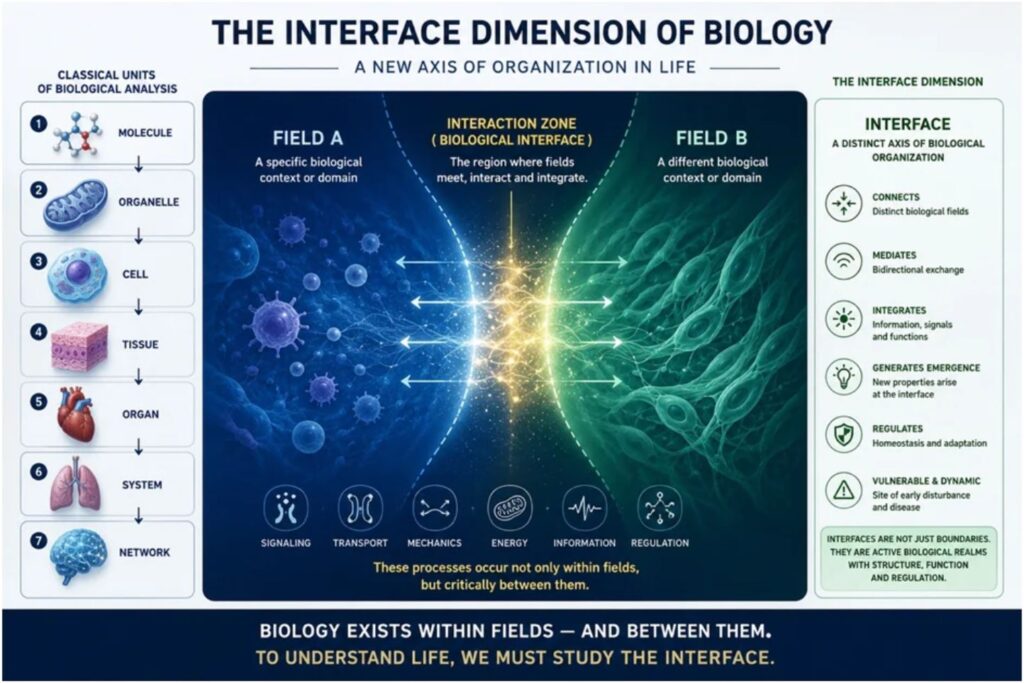
Modern biology and medicine organize a substantial part of their knowledge around molecules, organelles, cells, tissues, organs, organ systems, and biological networks. At the same time, different scientific disciplines have highlighted the functional significance of specific biological interfaces: organelle interfaces, cell–cell interfaces, epithelium–environment interfaces, neurovascular interfaces, maternal–fetal interfaces, host–microbiome interfaces, tissue–tissue interfaces, and biological tissue–artificial material interfaces.
These interfaces are not necessarily passive boundaries. In many cases, they constitute specialized domains of matter and information exchange, signaling, mechanical adaptation, immune regulation, secretory function, and maintenance of homeostasis.
However, these examples remain largely distributed across different scientific fields.
Based on the present literature review, no established general biomedical framework was identified that systematically approaches biological interfaces, across different organizational scales and between different types of domains, as a distinct category of potential functional units that can be examined through a common logic:
Biological Interface Principle
In the present paper, the Biological Interface Principle (BIP) is proposed. According to this principle, biological systems are regulated not only within their individual components, but also at the dynamic interfaces through which different biological domains interact with one another and with microbial, environmental, or artificial domains.
When such an interface develops emergent properties, specialized regulatory mechanisms, and a recognizable functional state, it is proposed that it may constitute a distinct unit of biological analysis.
From this principle emerge, for further investigation, the concepts of Interface Homeostasis, Interface Stress, Interface Adaptation, Interface Functional Reserve, Interface Phenotype, Interface Dysregulation, Interface Pre-Disease and Interface Failure.
A testable hypothesis is also formulated: in certain biological systems, loss of interface homeostasis may precede, cause, amplify, or transmit pathological changes within the domains connected by that interface.
A complementary Interface Dimension of Biology is therefore proposed. Its systematic study may give rise to Interface Biology, while its clinical translation may form a Medicine of Biological Interfaces.
Dermophthalmology and Rhinophthalmology are presented as early applied models in which this general principle may be translated from a theoretical framework into interdisciplinary research, measurable clinical models, shared care pathways, and, potentially, new structures of collaboration between medical specialties.