
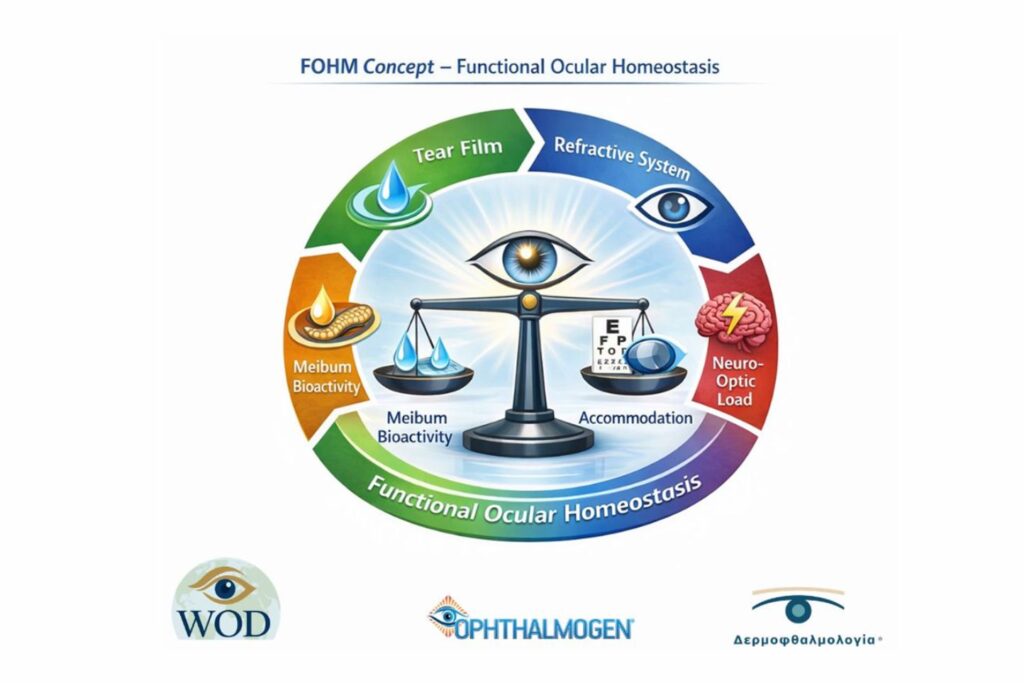
Functional Optical Homeostasis (FOHM)
A Unifying Dermophthalmologic Framework for Ocular Surface–Driven Visual Variability
WOD Position Paper No. 1 (2026)
Title: Functional Optical Homeostasis (FOHM)
Type: Scientific Consortium Position Paper / Conceptual–Translational Framework
Scope: Dermophthalmology (Eye–Skin Axis / Ophthalmoderma)
Status: Consensus Draft for Internal Scientific Review (Version 1.0)
Correspondence: WOD Scientific Secretariat (email to be added)
World Organization of Dermophthalmology (WOD)
Scientific Consortium Position Paper
Prepared by the WOD Scientific Consortium
Ocular Surface Study Group – Clinical Optometry – Dermophthalmologic Interface – Neuro-Optical Regulation
Executive Abstract
Visual clarity has traditionally been approached as a consequence of geometrical optics and refractive correction.
In the classical model, optical quality is primarily attributed to the crystalline lens, the cornea, and the accuracy of refractive power.
However, clinical experience and modern ocular surface research highlight an important parameter that is often underestimated:
thestability of the tear film and the functional state of the Ophthalmodermal Barrier.
This paper proposes the model of Functional Optical Homeostasis (FOHM), according to which visual clarity is not a static phenomenon but a dynamic, time-dependent property.
It is proposed that:
Optical Clarity (t) = Refraction × Surface Stability (t) × Neuroadaptation (t)
Within this framework:
- Refraction provides the geometric optical foundation
- The ocular surface regulates micro-optical stability
- The nervous system compensates for micro-fluctuations
FOHM does not replace existing ophthalmological models.
Rather, it integrates them into a regulatory framework that connects:
Optometry – Ophthalmology – Dermatology – Neuroscience
This approach offers:
- improved understanding of fluctuating blur
- reduction of unnecessary refractive prescription changes
- new composite evaluation indices
- a research framework for future clinical studies
WOD Consensus Statements
The Scientific Consortium of the World Organization of Dermophthalmology (WOD) formulates the following consensus statements:
- Functional visual clarity is time-dependent
In everyday patient experience, “clear vision” is not a static outcome but a dynamic property that may fluctuate over minutes or hours.
- Fluctuating blur frequently originates from the ocular surface
When blur varies during the day and improves after blinking (“blink-rescue”), ocular surface instability should be considered a primary mechanism.
- Refraction remains fundamental but not always sufficient
Accurate refractive correction is essential; however, reading endurance and perceived clarity are often influenced by tear film stability and eyelid function.
- The tear film represents the first optical interface
Tear film disruption increases light scattering, induces variability of higher-order aberrations, and reduces contrast sensitivity, contributing to functional visual variability.
- The Ophthalmodermal Barrier functions as a regulatory system
The complex consisting of:
- eyelid skin
- eyelid margin
- meibomian glands
- tear lipid layer
- blink mechanics
acts as an integrated regulatory unit controlling evaporation and surface stability.
- Neuro-optical load has clinical relevance
Repeated micro-instabilities of the ocular surface increase the need for cortical compensation, leading to visual fatigue and reduced endurance during prolonged near work.
- A “Surface-First” sequence may reduce unnecessary refractive changes
In cases of functional visual variability, stabilizing the ocular surface before final refractive adjustment may reduce the phenomenon of repeated prescription changes.
- FOHM constitutes a testable scientific framework
The model generates measurable hypotheses and composite indices (e.g., OSII, VSI) that can be evaluated in future clinical studies.