
The Tear Film as a Unifying Optical and Biological Interface
ABSTRACT
Background
Visual discomfort, intermittent blurred vision, ocular fatigue, and ocular-surface symptoms are increasingly common in modern populations, often in the absence of overt structural abnormalities. Despite major advances in ophthalmology, dermatology, and ocular-surface science, these phenomena remain incompletely explained within existing disease-centered frameworks.
Objective
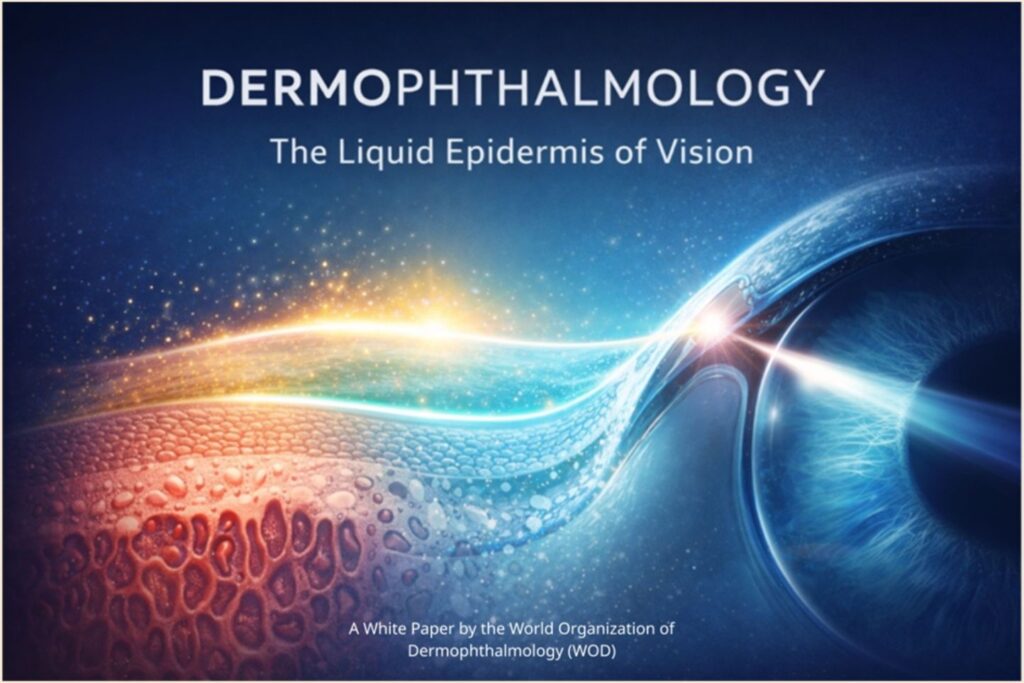
This paper proposes Dermophthalmology as a unifying scientific and clinical framework that redefines the ocular surface—with the tear film at its core—not merely as a moisturizing layer, but as a dynamic optical, biological, immunological, and environmental interface fundamental to vision quality and ocular health.
Methods
This white paper synthesizes evidence from ophthalmology, optical physics, dermatology, immunology, aerobiology, otolaryngology (ENT), neurology, and environmental medicine. Historical examples of unifying scientific frameworks are presented, and contemporary clinical and experimental observations are integrated regarding tear-film dynamics, eyelid function, microbiome balance, environmental exposure, and the neuroaesthetic processing of vision.
Results
The tear film emerges as the eye’s first refractive surface and as a functional extension of specialized periocular skin (Ophthalmoderma). Its stability depends on eyelid function, gland activity, microbiome balance, low-grade inflammation, environmental exposure, and neuroaesthetic integration. Fragmented, specialty-centered approaches often fail to fully explain functional symptoms, whereas the dermophthalmologic model accounts for symptom variability, early dysfunction, and opportunities for prevention.