
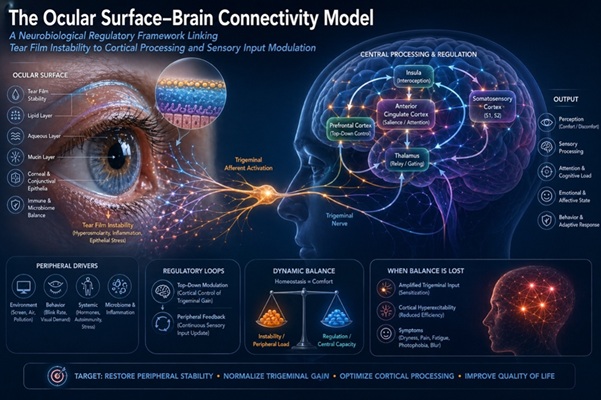
Dry eye disease has traditionally been treated as a localized condition of the ocular surface, centered on tear film instability and meibomian gland inflammation. However, the frequent mismatch between clinical signs and patient-reported symptoms, along with comorbidity with neurological pain syndromes, led the WOD (World Organization of Dermophthalmology) Scientific Working Group — drawing on experts from ophthalmology, neurology, neuroscience, pain medicine, dermatology, dentistry, otolaryngology, and functional neuroimaging — to search for a broader interpretive framework.
The result is the Ocular Surface–Brain Connectivity Model, a neurobiological proposal that treats the ocular surface not merely as an anatomical structure, but as a dynamic, high-density neurosensory interface. Under this framework, tear film instability may influence trigeminal sensory input and, through it, cortical processing efficiency and perceptual comfort — a phenomenon that becomes particularly relevant under conditions of chronic digital visual strain. A central regulatory role in this process appears to be played by the so-called Ophthalmodermal Barrier, whose integrity is linked to the stability of peripheral sensory load.
The paper does not redefine dry eye disease as a primary neurological disorder, but extends current understanding by situating it within a broader neuroregulatory framework, while also proposing testable research hypotheses for the field’s future direction. The practical significance of stabilizing this barrier — through eyelid hygiene — is discussed extensively in the text, and underlies the Ophthalmogen line of Dermophthalmology products.